
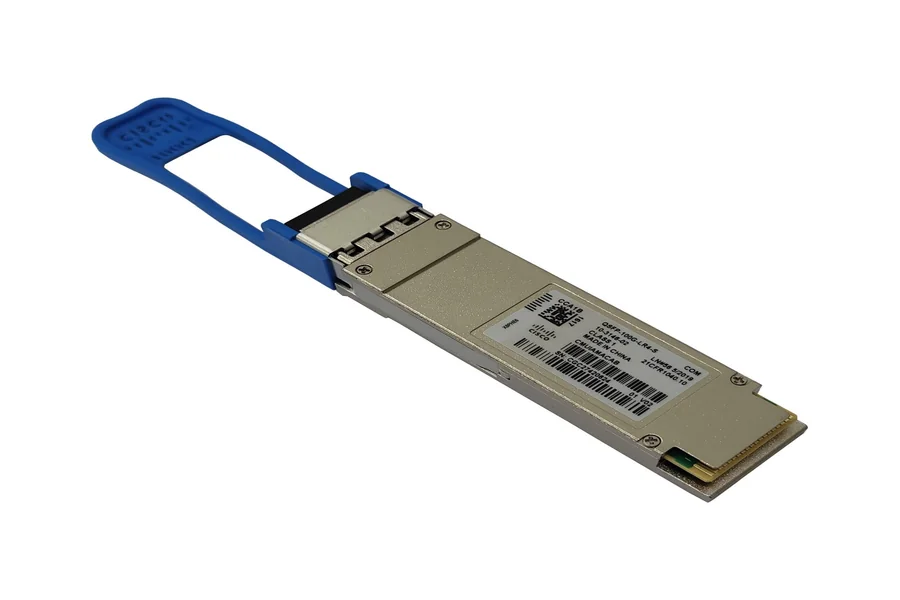
As cloud architectures continue to decentralize, the role of metro edge and distributed cloud nodes has become increasingly critical. Unlike hyperscale core data centers, these facilities are often spread across metropolitan areas, serving latency-sensitive workloads such as content delivery, financial transactions, 5G core functions, and edge AI inference. In this context, 100G IR4 optics are emerging as a highly practical solution for short-to-medium reach interconnects outside the core data center.
Beyond the Core Data Center
Metro edge and regional data centers typically operate under very different constraints than large hyperscale campuses. Space is limited, power budgets are tighter, and fiber infrastructure is often inherited rather than purpose-built. While 100G LR4 and ER4 modules provide long reach, their cost, power consumption, and tighter optical tolerances are often unnecessary for edge deployments where link distances are commonly between 2 km and 10 km.
100G IR4 is specifically designed for this middle ground. With a reach optimized for inter-building and metro edge links, IR4 delivers sufficient distance without the complexity or overhead associated with long-haul optics.
Enabling East–West Connectivity Between Edge Nodes
Modern distributed cloud models rely heavily on east–west traffi data exchanged laterally between peer nodes rather than flowing back to a centralized core. Examples include cache synchronization, workload migration, distributed storage replication, and microservice communication.
In these scenarios, predictable latency and stable throughput matter more than maximum reach. 100G IR4 supports consistent performance across typical metro distances while maintaining generous optical power margins. This makes it well suited for edge-to-edge interconnects, where links may traverse multiple patch panels, older splice points, or mixed-quality fiber segments.
Supporting Telecom and Cloud–Edge Convergence
Telecom networks are increasingly converging with cloud infrastructure, particularly in 5G and emerging 6G architectures. Distributed units (DUs), centralized units (CUs), and edge data centers must interconnect efficiently to support network slicing, low-latency services, and real-time analytics.
QSFP28 IR4 aligns well with these telecom-driven cloud edge deployments. Its use of single-mode LC duplex fiber simplifies integration with existing carrier-grade fiber plants, avoiding the operational complexity of MPO-based solutions. At the same time, IR4 offers sufficient reach to connect aggregation points, regional edge nodes, and local data centers within a metro area.
Stability and Optical Budget Advantages
One of the often-overlooked strengths of 100G IR4 is its optical budget margin. Compared to short-reach solutions like SR4, IR4 provides significantly higher tolerance to fiber loss, connector aging, and environmental variation. This is particularly valuable in edge environments, where infrastructure conditions may be less controlled than in flagship data centers.
At the same time, IR4 avoids the higher launch power and tighter dispersion constraints associated with LR4 or ER4 optics. The result is a more forgiving link that is easier to deploy, validate, and maintain over time, an important consideration for geographically distributed sites with limited on-site expertise.
Conclusion
As metro edge computing and distributed cloud nodes become foundational to modern networks, optical interconnect strategies must evolve accordingly. 100G IR4 strikes a balance between reach, stability, and operational simplicity, making it an ideal choice for non-core data center environments.